The wetlands cover just 5 to 10 % of the earth’s area, however they are an efficient reservoir for carbon, aid in water purification, habitat for flora and fauna, help in groundwater recharge and significantly reduce the climate change by sequestering carbon dioxide. Draining of wetlands leads to an increase in the decomposition rate of organic carbon. It further leads to release of greenhouse gasses that contribute to the climate change.
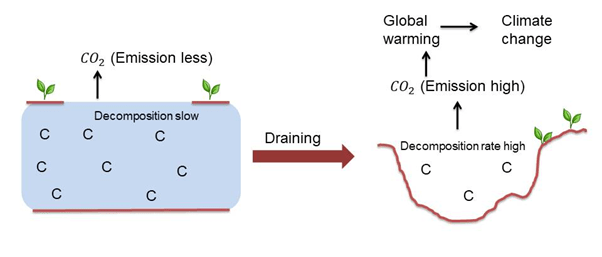
(Source: Taqdeer Gill)
Currently wetlands are being polluted by heavy metals and other industrial contaminants that can reduce the performance of a wetland or even kill its ecosystem entirely. Therefore restoration of wetlands and improving their performance is much needed. Biochar has been proposed to act as a good source for carbon sequestration and for fast restoration of wetlands into a natural state.
Biochar is an organic carbon, has a porous structure, is rich in nutrients and has a capacity to absorb various heavy metals from the wetlands. In addition to this, it acts as an agent for carbon sequestration and leads to reduction in greenhouse gasses such as CO2, CH4 and NO2. Biochar is prepared by pyrolysis of agricultural biomass under anoxic conditions at temperature above 250˚C. Biochar binds with soluble plant nutrients and reduces leaching. The biochar can be produced from several biomasses (wood, agricultural crop residues or animal manure) through a pyrolysis process.
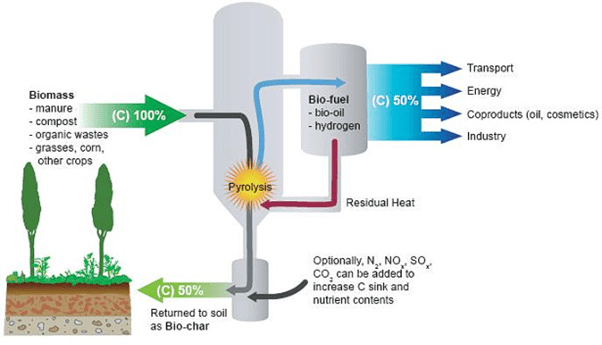
Method of biochar preparation
(Source: http://prakarsakolosa.blogspot.com/2012_10_01_archive.html)
(Source: Taqdeer Gill)
Positive impacts of biochar on wetland
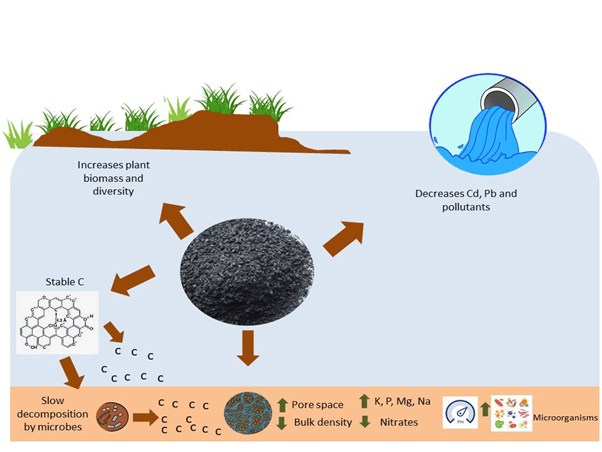
Increased soil carbon sequestration by biochar carbon (C): In a study from Japan on paddy wetlands, it was reported that application of biochar C reduced methane emission by 45.3 to 54.9%. Biochar C is not easily decomposed and therefore has slower turnover rates. The rationale for this change is that unlike labile C, biochar C is not easily decomposed and therefore has slower turnover rates.
Biochar decreases soil bulk density: Higher soil bulk density reduces the root penetration and ultimately negatively affects plant growth. Though different types of biochar will affect the bulk density differently but overall since biochar has a porous structure, it helps to reduce the soil bulk density.
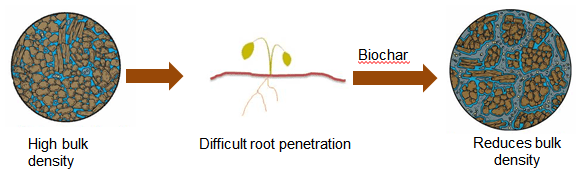
Effect of Biochar on the bulk density of soil
(Source: Taqdeer Gill)
Biochar can affect plant nutrient bioavailability: Biochar effectively reduces the nitrate content in wetlands and ultimately denitrification. Biochar derived from swine manure, when applied increases plant nutrients like K, P, Mg and Na which are essential for the growth and development of plants. It plays an important role in reducing leaching of nutrients.
Biochar amendment increases plant biomass: Biochar positively impacts plant shoot length and shoot number by increasing it.
Biochar improves chemical, physical and biological properties of the soil: Overall biochar has a positive role in the improvement of physical, chemical and biological properties of the soil. Electric conductivity increases with the addition of biochar into the soil. Rice husk biochar has positive effects on increasing the soil pH. Biochar derived from corn straw has been demonstrated to increase the stability of soil aggregates. While, corn straw biochar has been shown to increase the population of Actinobacteria and Acidobacteria which aids in carbon sequestration.
Biochar amendment of wetlands leads to an increase in plant diversity: Biochar derived from pig manure improves phosphorous content of the soil leading to growth of Polytrichum strictum which helps in establishment of sphagnum moss.
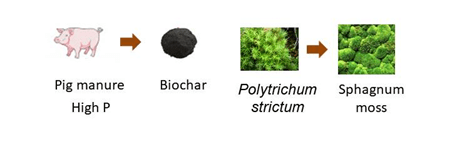
(Source: Taqdeer Gill)
Shortcomings and potential research
Mixed results have been observed with regards to the effect of biochar on wetland diversity. Application of various types of biochars has not been evaluated on a single wetland. Different studies have used different types of biochar. Most of the studies conducted until now are short-term studies (up to 4 months) while long-term and in-field studies are needed to capture a detailed effect on the wetland ecosystem. Most of the studies have been performed on constructed wetlands instead of naturally occurring wetlands. There is utmost need for enforcement of policies and laws to provide more funding for research regarding natural wetland restoration and remediation. More studies need to be conducted regarding the effects of different types of biochar on wetland restoration. Until now, recommendations regarding addition of soil amendments for wetland restoration are very few. Based on the literature so far, some recommendations or policy statements should be made. Furthermore, very few studies have been carried out comparing the application of biochar at different rates and in combination with other manures. There is a lack of research on the effect of biochar on the water Ph and the flora and fauna (macro and micro) of the wetland.
Conclusion
Literature reveals that biochar plays a role in wetland restoration. It helps in carbon sequestration, reduction in the bulk density of soil, reclamation of wastewater, reduction in heavy metal content of the soil and significantly improves plant growth and microbial population. Moreover it changes the soil pH, helps in soil aggregation, reduces emission of greenhouse gasses, improves plant diversity and reduces leaching of essential nutrients. However there is lack of comprehensive studies and recommendations on the use of biochar for wetland remediation and restoration.
 AGSC 5110 Research Methods
This is very educative, well done Taqdeer
LikeLike