
Tennessee State University has joined every other higher learning institution in the U.S with transitioning to mandatory online education. One can argue whether the transition was smooth, but this is our reality. Being forced online has questioned the need for in-person learning. I’ve been a part of many debates regarding online education. From a personal point of view, it seems as if online degrees still are not respected as much as traditional in-person institutions. Albeit, I do not have any survey data or statistical numbers to back up that last statement, this is solely a personal opinion and observation among my circle of associates.
I recently posted online about how I saw a clash in warning amongst my medical professional friends. My post specifically said
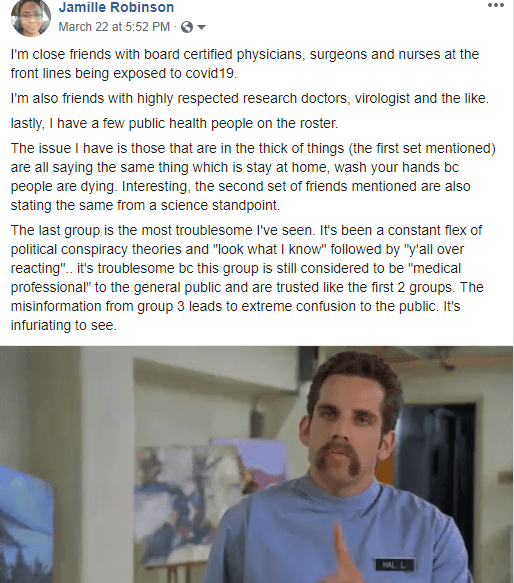
The following discussion included a lot of commentary regarding how many public health people get degrees online, and there s no way they can do the clinical work needed for these degrees. I had no opinion in this discussion because I am a bit ignorant about the requirements of public health professionals. The part of the conversation that attracted my attention was the overall lack of respect for those that indeed received online degrees. Who would have thought that the entire nation would be converting their semesters to online curriculum?
Now that we are officially fully online, I have gained a new respect for online degree programs. I love having the in-person experience, but there have been many times in lectures where I have thought to myself, “I didn’t need to come to class for this.” I’ve noticed that some professors have increased the amount of work and difficulty level of their exams now that we are online. It’s clear which of the academic staff was comfortable with the switch, and witch of them are having a hard time converting. For example, I have a class that is scheduled to have its first online class on April 8th due to the professor needing to “get things in order.” That last time we met was March 11th. Take what you want from that info.
Now that we are online, I’m wondering how many of the current in-person classes will be converted to digital courses in the future. It seems that the professors that are doing well with the conversion seem to enjoy the freedom allotted.
Every day I try to look at the positive in everything that is occurring. It’s a hard task to do, but I think to keep my mind from going crazy, it’s the best route to pursue. In doing so, I think one of the benefits of the COVID19 pandemic is that academic institutions will now need to reevaluate the benefits of offering more classes online seriously. Doing so could mean that more courses could be offered, and students could graduate sooner or actually in 4 years. The reality that all classes have been converted to online status means that classes that were usually only offered in the fall could now be offered in the spring and vice versa. The only caveat now is finding the workforce to teach the extra load. If accomplished, then this could be a boost for the university by hiring more adjunct professors that could teach core classes online.
I do not believe a complete conversion is possible for all disciplines, especially on the graduate side. There are disciplines such as engineering, biology, chemistry, architecture, and fashion design that need to be hands-on at some point in the educational process. I can’t imagine taking a biology lab online unless it starts becoming widely accepted to do the lab as a virtual reality component. I’m aware of some medical schools opting to do their human cadaver anatomy studies via virtual reality modules, especially in cases where there is a shortage of cadaver donations. If this technology is working in the medical field training, then is it plausible that it can succeed in biology training. There will still come the point where muscle memory will need to be implemented in these fields at some point, maybe at a higher level, such as residency or graduate school. For right now, I think the bright side of the current crisis is that we are being thrust into a new way of learning that may adversely benefit in the long run.
What are your thoughts? Do you still prefer to go to class in person? Do you think universities will open more programs to being offered online in the wake of this crisis?
 AGSC 5110 Research Methods